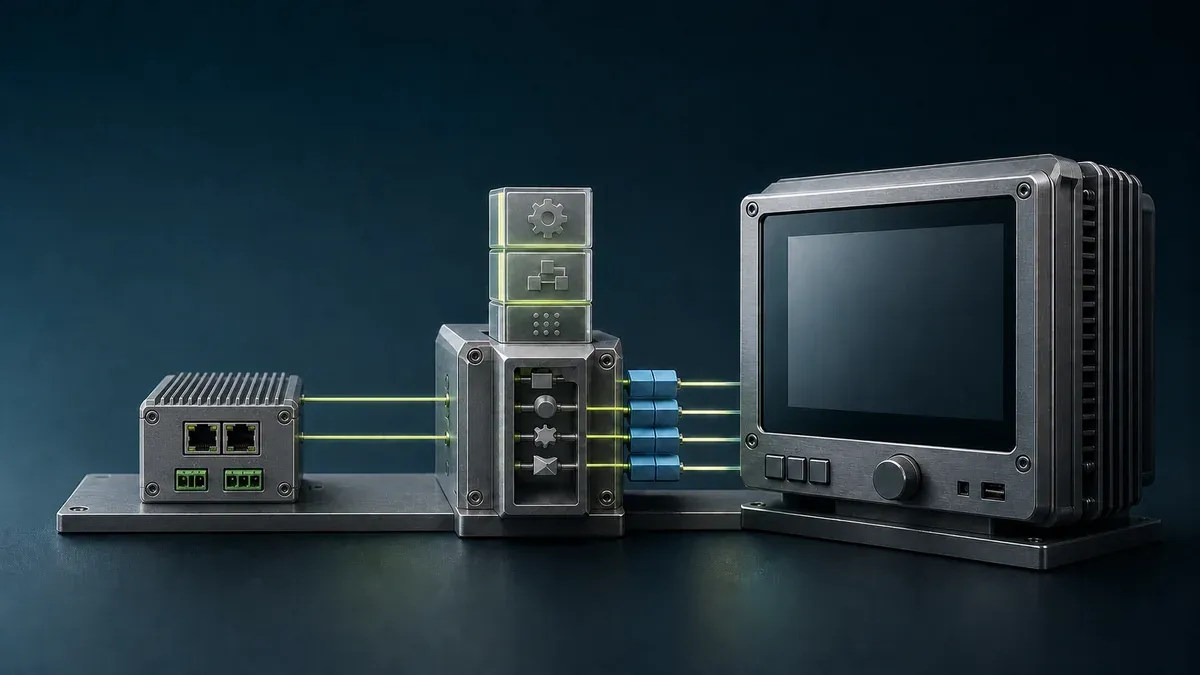
An industrial edge box is a broad label for compact computing or connectivity hardware installed near machines and production systems. It may be a connectivity-focused gateway, an application-focused edge computer, an industrial PC (IPC), or a device that combines those roles.
The best fit therefore comes from requirements, not the name on the product page. Define the workload, interfaces, environment, offline behavior, security operations, and replacement lifecycle before choosing the hardware class.
Why are these industrial edge terms confusing?
“Gateway,” “edge computer,” and “industrial PC” do not form three clean, mutually exclusive standards categories. Gateway describes what a system does between endpoints. Edge describes where computing happens relative to data and processes. IPC describes a computer’s intended hardware use and environmental characteristics.
Vendors also use the terms differently. A compact fanless computer may be sold as all three, while another product called a gateway may run only a fixed data-forwarding service. Compare verified capabilities and evidence rather than assuming a label guarantees compute capacity, protocol support, ruggedness, or maintainability.
The NIST fog computing conceptual model distinguishes distributed compute concepts and describes moving applications, management, and analytics closer to IoT data sources. It also notes that edge computing tends to run specific applications at a fixed logical location. This is a useful architectural idea, but it does not specify one industrial enclosure or processor type.
What is an industrial edge gateway?
An industrial edge gateway sits between equipment or local systems and another network, service, or application. Its scope may include acquiring selected data, filtering it, translating supported interfaces, buffering during an outage, enforcing a narrow boundary, or forwarding records upstream.
A gateway is a good center of gravity when the task is bounded:
- connect a defined set of sources and destinations
- normalize or filter a known data set
- store and forward records during short disconnections
- isolate a purpose-specific integration flow
- operate with a small, controlled software footprint
Limitations depend on the actual product. Some gateways have modest CPU, memory, and storage; others are full computers with containers or virtualized workloads. Some expose a fixed vendor configuration, while others require operating-system administration. Confirm every required interface, data type, update method, certificate feature, buffer limit, and failure behavior on the exact model and software version.
What is an industrial edge computer?
An edge computer runs applications close to the machine, line, building, or other data source. It may host data acquisition, a local database, dashboards, MES or SCADA services, analytics, integration logic, and management agents, subject to its supported platform and resources.
Choose an edge-compute orientation when the site needs several of these characteristics:
- multiple local applications or services
- more CPU, memory, or storage than a fixed gateway task needs
- local user interfaces or APIs
- application isolation and independent update cycles
- longer buffering or local history
- room to add defined workloads later
More flexibility also creates more operational responsibility. The team must manage the operating system, application dependencies, security updates, backups, storage growth, logs, service health, and recovery. “Runs containers” or “has an app marketplace” does not answer who owns those tasks over a five- or ten-year machine lifecycle.
Edge compute should not be confused with machine control. Local placement can reduce dependency on a remote service, but it does not automatically make a general-purpose application suitable for deterministic logic, interlocks, or safety functions.
What is an industrial PC or IPC?
An industrial PC is a general-purpose computer designed, configured, or qualified for specified industrial use. Compared with an office PC, an IPC may offer features such as extended environmental ratings, alternative cooling, industrial mounting, different power inputs, longer component availability, or serviceable storage—but none should be assumed without documentation.
The word “industrial” is not a universal certificate. Ask for the declared temperature range, humidity conditions, ingress protection where relevant, shock and vibration evidence, power tolerances, storage endurance, electromagnetic compatibility, and the standards or test methods behind each claim. IEC 61000-6-2:2016, for example, specifies generic electromagnetic-immunity requirements for electrical and electronic equipment in industrial locations when no dedicated product or product-family standard applies. It does not prove that every device marketed as an IPC meets that standard or fits every industrial environment.
An IPC might serve as an HMI, engineering workstation, vision computer, edge application host, gateway, or controller platform. Its role comes from the installed software and system design, not the chassis alone.
How do an edge gateway, edge computer, and IPC compare?
| Decision dimension | Industrial edge gateway | Industrial edge computer | Industrial PC (IPC) |
|---|---|---|---|
| Primary description | Connectivity and data-flow role | Local application-compute role | Hardware platform for stated industrial conditions |
| Typical scope | Defined acquisition, translation, filtering, buffering, forwarding | Multiple services, applications, databases, visualization, or analytics | General compute for HMI, edge, gateway, engineering, vision, or other roles |
| Software flexibility | Often bounded, but product-dependent | Usually broader, but requires lifecycle management | Broad if the OS and hardware allow it |
| Resource expectation | Sized for a defined flow; can range widely | Sized for application and storage workloads | Ranges from compact embedded systems to high-performance computers |
| Environmental meaning | “Industrial” still requires evidence | “Industrial” still requires evidence | Intended characteristic, but exact ratings and tests remain model-specific |
| Main selection risk | Assuming unsupported interfaces or insufficient buffering | Underestimating operations, storage, or application growth | Buying excess hardware or assuming the label proves site suitability |
| Overlap | Can be implemented on an edge computer or IPC | Can perform gateway duties and can be built as an IPC | Can host either gateway or edge-compute workloads |
The comparison is intentionally role-based. A single device can occupy more than one column.
Which option fits common manufacturing scenarios?
Choose a gateway-centered design when…
You have a stable, narrow exchange between known machines and a known destination; local application needs are minimal; and the required interface and buffering behavior are proven. A purpose-specific gateway can reduce moving parts, provided it has a supported security and update lifecycle.
Choose an edge-computer-centered design when…
You need local MES, SCADA, dashboards, data storage, diagnostics, or several independently managed services. Size it from measured data rate, retention, peak workload, update overhead, and failover behavior—not just average CPU use during a demo.
The distinction between MES and SCADA still matters inside an edge deployment. The MES vs SCADA guide explains their separate production and supervisory responsibilities.
Choose an IPC-centered platform when…
The workload needs general-purpose compute and the installation has explicit industrial environmental, mechanical, power, mounting, peripheral, or serviceability requirements. An IPC may then host the edge or gateway role. Validate the complete installed system, including power supply, storage, connectors, expansion cards, enclosure, airflow, and cables—not only the base computer’s data sheet.
Use separate devices when…
Risk, ownership, lifecycle, performance, or network boundaries make consolidation undesirable. A tightly scoped gateway can mediate one flow while a separate edge computer hosts applications. Separation may also limit the impact of application maintenance, but it adds hardware, patch, inventory, and monitoring work. Model both sides rather than assuming consolidation or separation is always safer.
What requirements should you document before selection?
Use this checklist for the exact site and model:
- Business and operational task: What decision, workflow, or record does the system enable? What happens if it is unavailable?
- Application workload: Services, OS, architecture, CPU, memory, acceleration, dependencies, peak behavior, and future headroom.
- Data workload: Sources, values per second, event bursts, record size, retention, writes per day, and acceptable loss.
- Interfaces: Exact electrical/network interfaces, supported software roles and versions, licensing, and conformance evidence.
- Environment: Temperature at the mounting location, humidity, dust, water, vibration, shock, altitude, corrosive exposure, and ventilation.
- Power and installation: Input range, transients, grounding, UPS needs, enclosure, rail/panel/rack mounting, clearances, and cable strain relief.
- Availability: Boot time, watchdog behavior, storage failure, database recovery, backup, spare unit, restore time, and safe degraded mode.
- Security: Identity, least privilege, secure boot or hardware trust where required, encryption, key rotation, logging, patching, and vulnerability response.
- Lifecycle: OS support period, application support, component availability, configuration export, reproducible provisioning, and end-of-life migration.
- Ownership: Who monitors, approves changes, responds to alarms, restores backups, and maintains the asset inventory?
A procurement matrix should distinguish “required,” “preferred,” and “not applicable,” then link each mandatory line to supplier evidence or an acceptance test.
How should security affect the hardware decision?
Edge devices often touch both operational data and other networks, so their placement can create a consequential trust boundary. NIST SP 800-82 Rev. 3 recommends securing OT with its performance, reliability, and safety constraints in mind. IEC 62443-3-3 defines system security requirements within a zones-and-conduits approach.
Translate those principles into the design: allow only required flows; separate administrative access from application traffic; use unique identities; disable unused services; restrict write paths; protect credentials; log changes; maintain recoverable configurations; and define how patches are tested and deployed. Hardware security features can help, but they do not compensate for shared passwords, an unmaintained OS, unrestricted routes, or missing backups.
Do not let an integration convenience bypass the control hierarchy. An edge application can read production data or submit an approved request, but PLC logic and safety authority should remain where the engineered design places them.
What offline and data-quality limits matter?
“Works offline” is incomplete unless duration and behavior are specified. Ask how much data can be buffered, what is dropped first, whether timestamps come from the source or receipt time, how duplicates are detected, and what happens when storage is full. Test power loss during a write and network recovery after the buffer has accumulated.
Also separate unknown from stopped. If a cable is disconnected, reporting the machine as stopped may corrupt downtime and OEE calculations. Observability should distinguish application failure, interface failure, bad-quality data, stale data, and a genuine process state.
Where does Orenda Box fit?
Orenda Box is a small on-site edge computer for configured PLC and machine data and local applications. It can run Orenda MES for run/stop history, OEE, downtime, and reports, and Orenda SCADA for configured PLC-tag dashboards, alarms, and trends. The PLC remains responsible for machine control.
Choose Orenda Box when the project needs the local applications as well as the machine-data connection. Start with the workload, the controller and interfaces, storage needs, and the mounting environment. Model-specific electrical and environmental specifications belong in the installation check. A pilot on one machine can verify the data, application, restart, and remote-service workflow before extending it to other equipment.
What is the final takeaway?
Choose an industrial edge gateway for a bounded connectivity role, an edge computer for broader local application workloads, and an IPC when the compute platform must meet explicit industrial installation requirements. Expect overlap, and let one device fill multiple roles only when the workload, risk, and lifecycle case supports it.
The strongest selection document is not a list of category names. It is a testable set of requirements covering application behavior, data integrity, environment, security, recovery, ownership, and replacement.